

Families, in their various forms, have been essential to television since that light first came on. They can be ideal or nightmarish, or both, or somewhere in between, and we accept them—be they Waltons, Addams, or Simpsons—according to our experience or our desires, having known our families or wishing for something different from what we had.
In “Schitt’s Creek,” Dan Levy co-created—along with his father, Eugene—one of the medium’s greatest family comedies. It was a show that grew over time from a basic premise about rich people losing their money and being forced to live in close proximity to each other in motel rooms to an ode to love, understanding, and acceptance. It swept the comedy categories at the 2020 Emmys, including acting awards for the Levys, Catherine O’Hara, and Annie Murphy, and writing and directing trophies for Dan.
“To the family” are, in fact, the last words spoken in the first season of “Bad Mistakes,” Levy’s raucous and funny new show, co-created with Rachel Sennott and now streaming on Netflix—though, given what precedes it, that’s less of a blessing than a curse. Levy plays Nicky, a pastor at a sparsely attended, nondenominational suburban New Jersey church. He’s out as gay but presumably celibate; that he has a boyfriend, Tareq (Jacob Gutierrez), is known only to Tareq; this, of course, creates a secret, which creates pressure, which creates comedy.
Sister Morgan (Taylor Ortega) is an elementary school teacher, a job that doesn’t quite fit with everything else we see of her—it’s barely depicted, anyway, as summer approaches—and she has a longtime boyfriend, Max (Jack Innanen), who has decided now is the time to propose. She once tried her hand at acting in New York, which means she once lived a wilder life and is something of an improviser. Their mother, Linda (Laurie Metcalf), a hardware store owner, is running for mayor, and the campaign is being managed by her extra-special daughter Natalie (Abby Quinn).
The series begins when their grandmother is dying, and on Linda’s orders, they rush to buy her a gift: Linda is trying to celebrate an “early birthday” before her mother dies. And because she’s that kind of person, Morgan steals what she imagines is a cheap necklace from a convenience store. (The clerk, Yusuf, played by Boran Kuzum, will have his hands full.) The necklace isn’t cheap, it turns out, for no particularly good reason, and the convenience store isn’t just a convenience store, but a sort of transit station for stolen goods run by local Russian mobsters. As a result, Morgan and Nicky find themselves forced to run errands for them, under threat of death, or worse.
The show gets very complicated on its way to a semi-circular conclusion; there’s a lot going on, with Linda’s mayoral ambitions and various relationship problems. (Elizabeth Perkins plays Max’s mother, connecting the plots.) But it’s a nice twist, and classic in its own way; the search for the phrase “blending in with the gangsters” brings up a host of old comedies. In the most difficult situations, brother and sister aren’t afraid to argue. Nicky wishes he were somewhere else, while Morgan finds it invigorating. Although it’s all improbable, the parts fit together perfectly; they make TV sense.
Infine, la serie poggia sulle spalle dei tre attori principali, che sono semplicemente un piacere da guardare; la telecamera obbliga avvicinandosi. Levy porta con sé un’affanno pacato che potresti riconoscere dal suo David Rose in “Schitt’s”; il suo “OK” sussurrato a bassa voce, che potrebbe semplicemente significare “smettila di parlare”, è quasi un marchio di fabbrica. Ortega conferisce una sorta di intensità alla sua bambina rinata, mentre Metcalf interpreta Linda con una sorta di intensità operistica da piccola città, con gli occhi spalancati e la pronuncia precisa – è come una cugina di campagna di Moira Rose di O’Hara – come se fosse sul palco a lanciarsi nell’ultima fila del teatro.
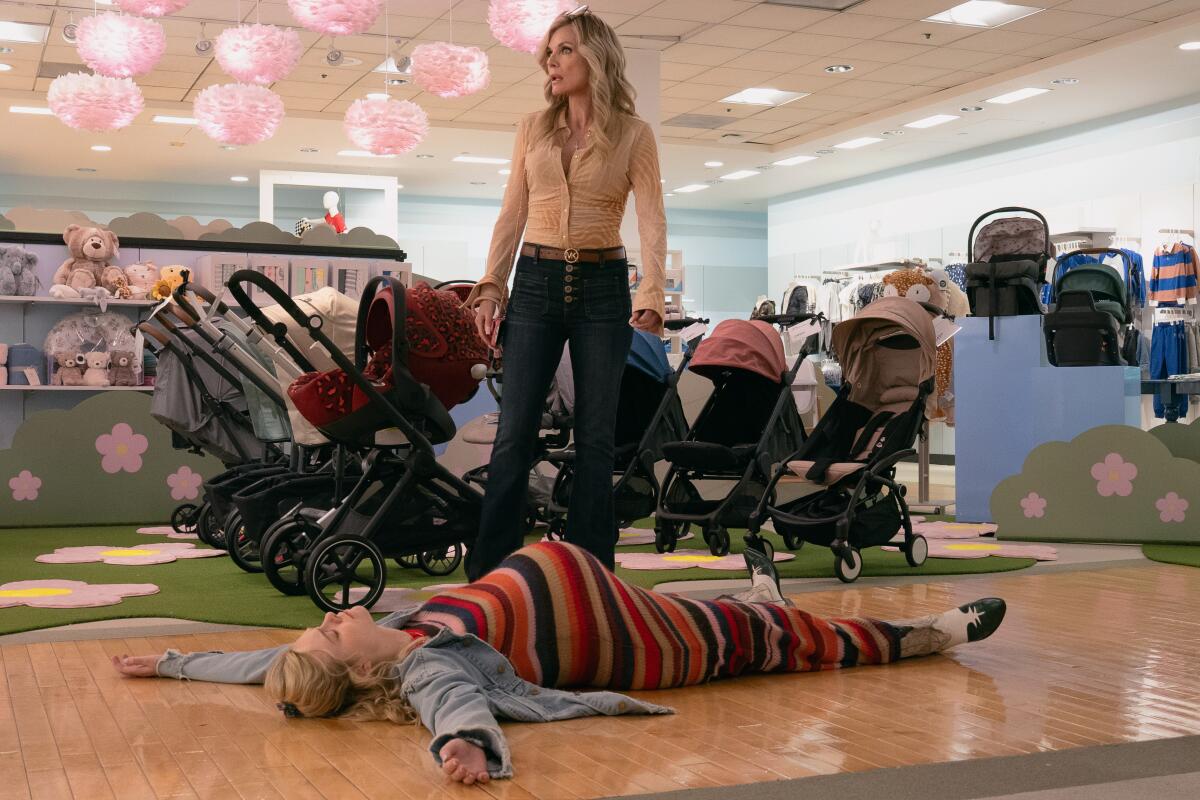
Michelle Pfeiffer ed Elle Fanning in “Margo’s Got Money Troubles”, in anteprima il 15 aprile 2026 su Apple TV.
(Allyson Riggs/Per gentile concessione di Apple)
In “Margo’s Got Money Problems”, in anteprima mercoledì su Apple TV, Elle Fanning interpreta il personaggio del titolo, una studentessa universitaria lusingata a letto dal suo professore di scrittura sposato con figli, Mark (Michael Angarano), nonostante io le gridi allo schermo di non farlo. Ben presto rimane incinta, e subito dopo diventa la madre essenzialmente single della piccola Bodhi, incapace di trovare lavoro o il tempo per scrivere. (Come eroina, presumiamo il suo talento).
Presumibilmente in cerca di un po’ di normalità, la madre di Margo, Shyanne (Michelle Pfeiffer), un’ex ragazza che si diverte – ma ancora brillante – si è fidanzata con Kenny (Greg Kinnear), cristiano, schietto e sincero; il Ralph Bellamy del pezzo, non ti viene chiesto di prenderlo abbastanza sul serio (anche se Kinnear lo interpreta in modo schietto). L’ex marito di Shyanne è Jinx, un ex wrestler professionista, interpretato da Nick Offerman con l’effetto di basso profilo di Ron Swanson, ulteriormente attenuato; la depressione e la dipendenza dalla droga ti faranno questo. Appena uscito dalla riabilitazione, scambia la cintura del campionato con una motocicletta e si unisce alla famiglia; sebbene abbia lasciato Margo presto e, a differenza di Shyanne, dimostra di avere un modo meraviglioso e semplice con Bodhi. (Il bambino stesso, o i bambini – usano i gemelli per questo lavoro – sono meravigliosi.)
Also staying at the residence is roommate Susie (Thaddea Graham), a cheerful cosplayer—and coincidentally Jinx’s biggest fan—whose skills will prove invaluable when Margo, desperate for cash, embarks on the world of OnlyFans. After collecting tips describing followers’ penises in terms of Pokémon (no explanation felt necessary), she focuses on videos, assembling increasingly elaborate sexy sci-fi productions alongside Susie (set and costumes), Jinx (storytelling advice, stunt coordinator), and OnlyFans veterans KC (Rico Nasty) and Rose (Lindsey Normington), a fabulous tag team Margo turns to for advice. (Margo seems to be taking over, but her name is in the title, so there you have it.) This introduces an element of Mickey Mouse and Judy, My Uncle Has a Barn, Let’s Put on a Comedy Show. More importantly, it builds a team, merging the family you create with the family you have.
It’s as sweet as can be. Aside from sleeping with your professor—students, don’t do it!—the show is positive about pretty much everything: motherhood, daughters, professional wrestling, second chances, sex work, cosplay, and the way art shows up in strange places. Only Marcia Gay Harden, as Mark’s mother, Elizabeth, is a real villain, and you’ll hate her.
The series was created by David E. Kelley (Mr. Michelle Pfeiffer), based on Rufi Thorpe’s 2024 novel, once again under the aegis of Nicole Kidman’s Blossom Films (following their collaborations on “Big Little Lies,” “Nine Perfect Strangers,” and “Love & Death”), with its signature quality, capital-Q, well-padded house style (distinguished, in its pop-cult genre, by its prestige). (Kidman has a small role as a wrestler-turned-lawyer, and it’s been a while since I’ve seen her used so well.) “Margo’s Got Money Problems” can be terribly sentimental, almost banal—the climax is pure Hollywood—but undeniably effective. And while its mix of comedy and drama can be a little unsettling, you won’t have to worry about where it ends.